Director Mode: The Scene Creation Pipeline
“We don’t write scenes. We manufacture them with precision engineering.”
Director Mode is where the magic happens. After completing your Story Bible (ARCHITECT Mode) and calibrating your voice (VOICE Mode), you enter the drafting phase with a complete creative infrastructure supporting every word.
The Problem with “Just Write”
Traditional AI writing assistance works like this:
- You: “Write me a scene where Mickey enters the casino.”
- AI: Generates something generic
- You: “No, that’s not right…”
- AI: Generates something slightly different but still generic
- Repeat until frustrated.
The fundamental problem? The AI doesn’t know your novel. It doesn’t know Mickey’s fatal flaw, your voice preferences, or what happened in the previous scene.
The Director Mode Solution
Director Mode treats scene creation like a manufacturing pipeline—not a guessing game.
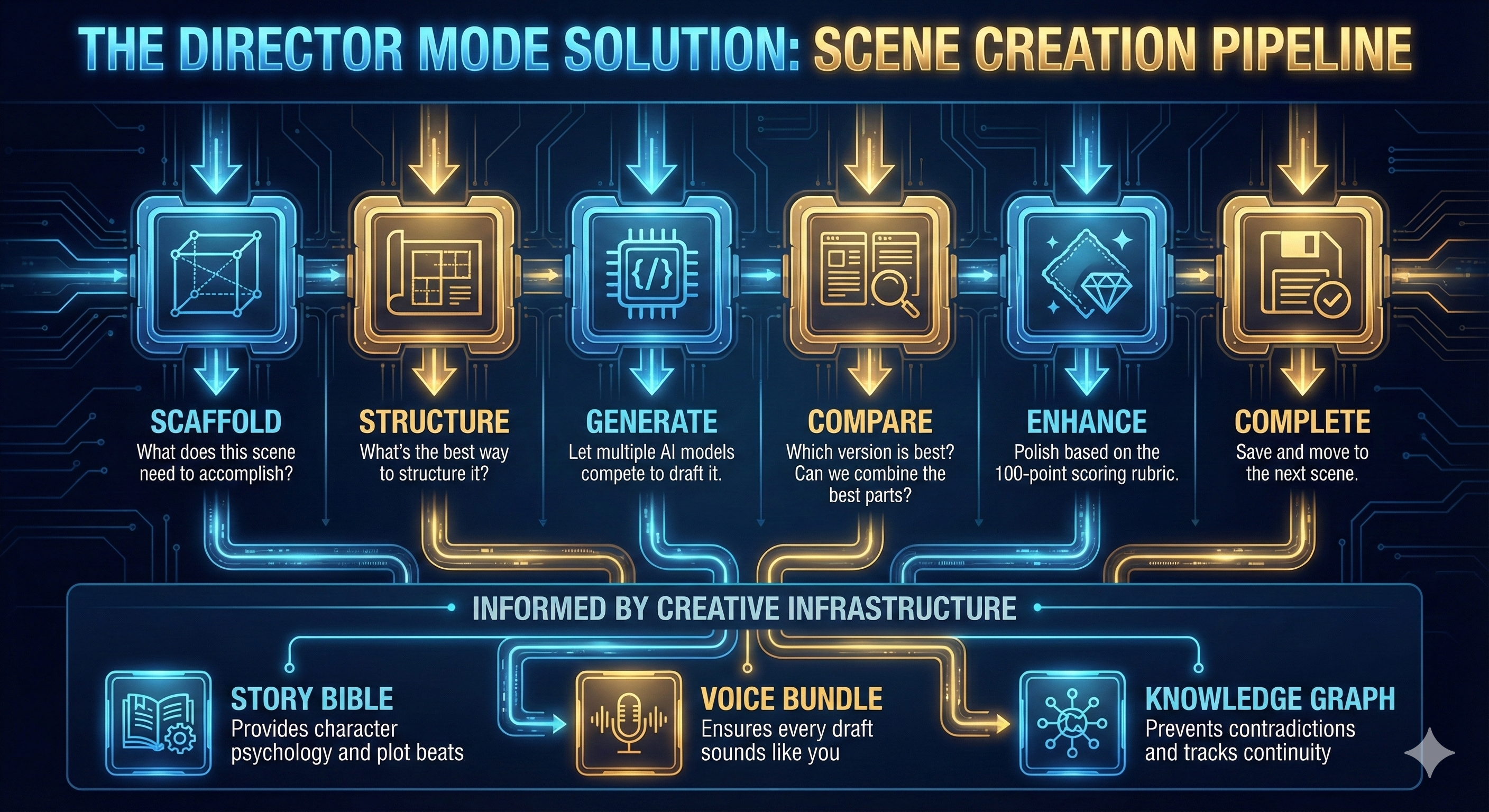
Each step is informed by your creative infrastructure:
- Your Story Bible provides character psychology and plot beats
- Your Voice Bundle ensures every draft sounds like you
- Your Knowledge Graph prevents contradictions and tracks continuity
The 6 Steps Explained
Step 1: Scaffold
Before any AI writes a word, we build a strategic briefing document.
You provide:
- Chapter and scene number
- Which beat this serves (from your Beat Sheet)
- Characters present
- A brief description of what happens
The system adds:
- Character psychology (Fatal Flaw, The Lie)
- Previous scene continuity
- Voice requirements from your Voice Bundle
- World rules that apply
- Optional: Research from NotebookLM
The output: A comprehensive scaffold that tells the AI everything it needs to know—not just what to write, but how to write it for your specific novel.
Deep Dive: For the full technical breakdown of scaffold assembly—including beat context, character ensemble, prior scene summaries, and the data flow from Story Bible to prompt—see Scene Scaffolding Architecture.
Step 2: Structure
Not every scene should be structured the same way. A chase scene has different pacing than a confession scene.
The system generates 5 structural approaches:
| Approach | Best For | Pacing |
|---|---|---|
| Action-Forward | Chase, fight, escape | Fast |
| Character-Driven | Internal conflict, decisions | Medium |
| Dialogue-Heavy | Negotiations, revelations | Slow-Medium |
| Atmospheric | Setting establishment, mood | Slow |
| Balanced | Standard scenes | Varied |
You choose the structure that fits the scene’s emotional needs.
Step 3: Generate (The Tournament)
Here’s where the manufacturing power kicks in.
Instead of asking one AI to write one draft and hoping for the best, we run a tournament:
- 3 AI models (Claude, GPT-4o, DeepSeek)
- 5 writing strategies each (Action, Character, Dialogue, Brainstorming, Balanced)
- 15 total variants generated in parallel
Each variant is automatically scored against the 100-Point Rubric:
| Category | Points | What It Measures |
|---|---|---|
| Voice Authenticity | 30 | Does it sound like YOU, not generic AI? |
| Character Consistency | 20 | Does behavior match established psychology? |
| Metaphor Discipline | 20 | Are metaphor domains diverse? No saturation? |
| Anti-Pattern Compliance | 15 | Zero forbidden constructions? |
| Phase Appropriateness | 15 | Does voice complexity match story phase? |
Result: You see a grid of 15 options, each with a quality score. No more guessing which version is better—the rubric tells you.
Step 4: Compare & Select
With 15 scored variants, you have real options:
- Select the best: Usually the highest-scoring variant
- Compare 2-4: Side-by-side view with score breakdowns
- Create a hybrid: “Use the opening from Claude-Character, the middle from GPT-Dialogue, and the ending from DeepSeek-Action”
The system makes it easy to see exactly why each variant scored the way it did, so you can make informed creative decisions.
Step 5: Enhance
Even the best draft can be improved. Based on the score, the system recommends an enhancement approach:
| Score | Recommendation | What Happens |
|---|---|---|
| 85+ | Action Prompt | Surgical fixes—specific line changes |
| 70-84 | 6-Pass Enhancement | Full polish pipeline |
| <70 | Regenerate | Start over with different approach |
Action Prompt example:
The scene scores 91/100 but has these specific issues:

1. Line 42: "with practiced precision" → Zero-tolerance violation
   FIX: Replace with direct metaphor showing precision

2. Lines 78-92: Gambling metaphors at 38% → Approaching saturation
   FIX: Replace 2 gambling metaphors with boxing domain

3. Line 156: Character trusted authority without reading angles
   FIX: Add internal resistance per Fatal Flaw
You can preview the fixes before applying them.
Step 6: Complete
The scene is done. The system:
- Saves the final draft to your manuscript
- Updates the Knowledge Graph with new facts
- Resolves any FORESHADOW → CALLBACK edges
- Recalculates tension levels
Then you choose what’s next:
- Start the next scene
- Review the full chapter
- Return to dashboard
- Edit in the Monaco editor
The Integration Architecture
Director Mode doesn’t work in isolation. Every step pulls from your complete creative infrastructure:
┌─────────────────────────────────────────────────────────────────────────┐
│                        SCENE GENERATION REQUEST                          │
├─────────────────────────────────────────────────────────────────────────┤
│                                                                         │
│   ┌─────────────────────────────────────────────────────────────────┐   │
│   │                    CONTEXT ASSEMBLY                              │   │
│   ├─────────────────────────────────────────────────────────────────┤   │
│   │                                                                   │   │
│   │   Story Bible          Voice Bundle         GraphRAG              │   │
│   │   ├── Protagonist      ├── Gold Standard    ├── Ego-graph        │   │
│   │   ├── Beat Sheet       ├── Anti-patterns    ├── Active conflicts │   │
│   │   ├── Theme            ├── Metaphor domains ├── Unresolved       │   │
│   │   └── World Rules      └── Phase voice          foreshadows      │   │
│   │                                                                   │   │
│   └─────────────────────────────────────────────────────────────────┘   │
│                              │                                          │
│                              ▼                                          │
│   ┌─────────────────────────────────────────────────────────────────┐   │
│   │                     LLM GENERATION                               │   │
│   │                                                                   │   │
│   │   The AI receives ALL relevant context before writing a word.    │   │
│   │   It cannot hallucinate because it has the facts.                │   │
│   │   It cannot sound generic because it has your voice.             │   │
│   │                                                                   │   │
│   └─────────────────────────────────────────────────────────────────┘   │
│                              │                                          │
│                              ▼                                          │
│   ┌─────────────────────────────────────────────────────────────────┐   │
│   │                    VERIFICATION                                   │   │
│   │                                                                   │   │
│   │   After generation, the system checks:                           │   │
│   │   - Dead characters don't appear                                 │   │
│   │   - Anti-patterns eliminated                                     │   │
│   │   - POV consistent                                               │   │
│   │   - Timeline coherent                                            │   │
│   │   - Voice authentic                                              │   │
│   │                                                                   │   │
│   └─────────────────────────────────────────────────────────────────┘   │
│                              │                                          │
│                              ▼                                          │
│   ┌─────────────────────────────────────────────────────────────────┐   │
│   │                    GRAPH UPDATE                                   │   │
│   │                                                                   │   │
│   │   New facts are extracted and added to the Knowledge Graph:      │   │
│   │   - New entities → add nodes                                     │   │
│   │   - New relationships → add edges                                │   │
│   │   - Resolved foreshadows → convert to CALLBACKS                  │   │
│   │   - Tension recalculated                                         │   │
│   │                                                                   │   │
│   └─────────────────────────────────────────────────────────────────┘   │
│                                                                         │
└─────────────────────────────────────────────────────────────────────────┘
The 100-Point Rubric
Every scene is scored objectively. Here’s how:
Voice Authenticity (30 points)
| Test | Points | Question |
|---|---|---|
| Authenticity | 10 | Does this sound like the POV character observing, or AI explaining the character? |
| Purpose | 10 | Does every beat serve the theme? |
| Fusion | 10 | Are technical/specialized concepts fused with character voice? |
Character Consistency (20 points)
| Test | Points | Question |
|---|---|---|
| Psychology | 8 | Does behavior match Fatal Flaw and The Lie? |
| Capability | 6 | Are all actions within established limits? |
| Relationships | 6 | Do interactions match established dynamics? |
Metaphor Discipline (20 points)
| Test | Points | Question |
|---|---|---|
| Domain Rotation | 10 | No single domain >30%? |
| Simile Elimination | 5 | Direct metaphors instead of “like” comparisons? |
| Transformation | 5 | Objects BECOME metaphors through active verbs? |
Anti-Pattern Compliance (15 points)
Start at 15, deduct for violations:
- -2 per zero-tolerance violation (e.g., “with practiced precision”)
- -1 per formulaic pattern (e.g., excessive adverbs)
Phase Appropriateness (15 points)
| Test | Points | Question |
|---|---|---|
| Complexity | 8 | Does voice complexity match story phase? |
| Earned Language | 7 | Is specialized terminology justified by this point in the story? |
Real Example
Scenario: Writing Chapter 4, Scene 1 — Mickey enters the casino for the first time since the incident.
Step 1 (Scaffold): System pulls Mickey’s psychology (needs control, hides vulnerability), casino world rules, previous scene summary, and voice requirements.
Step 2 (Structure): Writer chooses “Character-Driven” — internal conflict → external trigger → decision.
Step 3 (Generate): 15 variants produced in ~30 seconds. Top scorer: Claude Sonnet - Character at 91/100.
Step 4 (Compare): Writer compares top 3, notices GPT has a better opening. Creates hybrid.
Step 5 (Enhance): Hybrid scores 89. System suggests Action Prompt with 3 surgical fixes. Applied → 94/100.
Step 6 (Complete): Scene saved. GraphRAG updated with new facts. Mickey’s TENSION_LEVEL increases. Ready for Scene 2.
Time: ~5 minutes for a polished, voice-consistent, continuity-verified scene.
Why This Works
Traditional AI writing fails because:
- No memory — Every request starts from scratch
- No voice — Generic prose that sounds like everyone
- No verification — Hallucinations and contradictions slip through
- No options — You get one draft and hope it’s good
Director Mode succeeds because:
- Full context — Story Bible + Voice Bundle + Knowledge Graph
- Your voice — Calibrated through tournament selection
- Automated checks — 100-point rubric catches problems
- 15 options — Explore creative space systematically
For Developers
Engineering students working on the codebase can find technical specifications in the GitHub repository:
technical_manual/- Architecture, backend, frontend documentationdocs/tasks/- Implementation task specsdocs/specs/- Technical specifications
Related Documentation
| Document | Description |
|---|---|
| Scene Scaffolding | Technical deep-dive on scaffold assembly and prompt engineering |
| Voice Calibration | How we capture your voice |
| GraphRAG | The knowledge graph that powers verification |
| Research Graph | Three-system architecture |
| Writer’s Journey | The complete creative workflow |
Director Mode: Where preparation meets production.