The Cyborg Novelist: Engineering the Muse
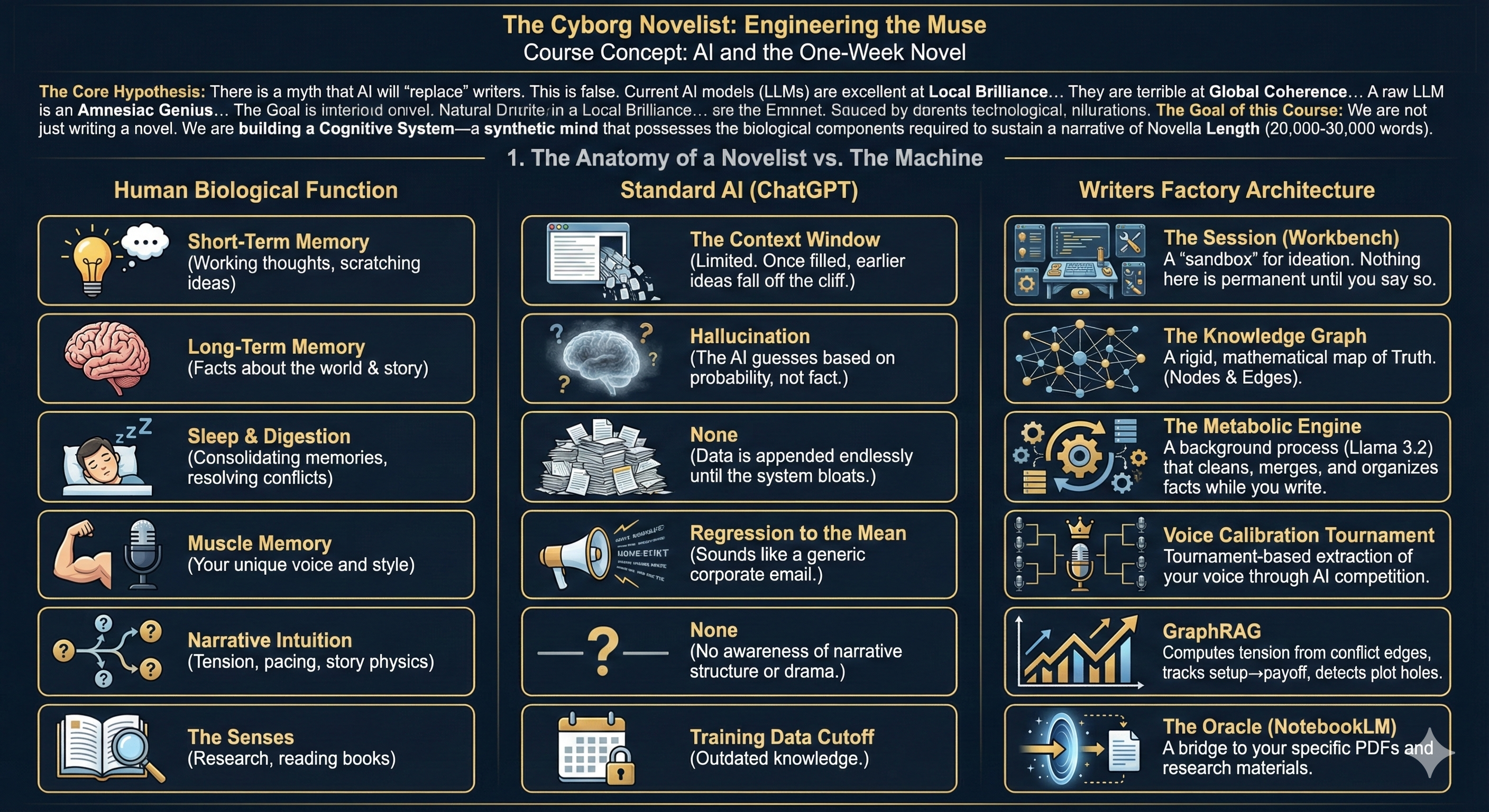
Course Concept: AI and the One-Week Novel
The Core Hypothesis
There is a myth that AI will “replace” writers. This is false.
Current AI models (LLMs) are excellent at Local Brilliance (a witty sentence, a vivid paragraph).
They are terrible at Global Coherence (a 300-page arc, consistent character psychology, thematic resonance).
A raw LLM is an Amnesiac Genius. It has read every book in existence, but it cannot remember what it wrote three pages ago. It has no subtext, no subconscious, and no long-term memory.
The Goal of this Course: We are not just writing a novel. We are building a Cognitive System—a synthetic mind that possesses the biological components required to sustain a narrative of Novella Length (20,000 words minimum, 40,000-50,000 words goal).
1. The Anatomy of a Novelist vs. The Machine
To write a novel, a human uses distinct cognitive functions. Standard AI chat interfaces (like ChatGPT) only use one. We will build the rest.
| Human Biological Function | Standard AI (ChatGPT) | Writers Factory Architecture |
|---|---|---|
| Short-Term Memory (Working thoughts, scratching ideas) | The Context Window (Limited. Once filled, earlier ideas fall off the cliff.) | The Session (Workbench) A “sandbox” for ideation. Nothing here is permanent until you say so. |
| Long-Term Memory (Facts about the world & story) | Hallucination (The AI guesses based on probability, not fact.) | The Knowledge Graph A rigid, mathematical map of Truth. (Nodes & Edges). |
| Sleep & Digestion (Consolidating memories, resolving conflicts) | None (Data is appended endlessly until the system bloats.) | The Metabolic Engine A background process (Llama 3.2) that cleans, merges, and organizes facts while you write. |
| Muscle Memory (Your unique voice and style) | Regression to the Mean (Sounds like a generic corporate email.) | Voice Calibration Tournament-based extraction of your voice through AI competition. |
| Narrative Intuition (Tension, pacing, story physics) | None (No awareness of narrative structure or drama.) | GraphRAG Computes tension from conflict edges, tracks setup→payoff, detects plot holes. |
| The Senses (Research, reading books) | Training Data Cutoff (Outdated knowledge.) | NotebookLM Integration A bridge to your specific PDFs and research materials. |
2. The Problem: The “Context Window” Cliff
When you write a novel in a standard chat window, you are fighting a losing battle against entropy.
- Word 1: Perfect coherence.
- Word 10,000: The AI forgets your protagonist’s eye color.
- Word 20,000: The AI forgets the villain’s motivation.
- Word 30,000: The plot dissolves into generic tropes.
The Solution: We do not force the AI to remember everything. We externalize memory.
We treat the story not as a String of Text, but as a System of Truth.
3. The Architecture: How We Will Build It
We are building a Metabolic System. Just as your body digests food to build muscle, our system digests text to build story.
Phase 1: The Workbench (The Mouth)
You chat with the AI. You throw ideas around. This is messy. It is ephemeral.
- Technique: Session Management.
- Rule: “Don’t save the noise.”
Phase 2: The Digestion (The Stomach)
This is the breakthrough. When you finish a scene and hit SAVE, a background agent (a local, private model running on your laptop) wakes up.
It reads your scene and asks:
- New Entities? (Did we meet a new character?)
- New Facts? (Did Mickey lose his gun?)
- Conflicts? (Wait, in Chapter 1 you said Mickey never carries a gun!)
If it finds a conflict, it flags it. It keeps the “World Bible” clean so the “Brain” doesn’t get confused.
Phase 3: The Graph (The Brain)
This is the source of truth. When you go to write Chapter 10, the AI doesn’t just “guess” what happened in Chapter 1. It queries the Brain:
- “Who is alive?”
- “Who hates whom?”
- “What is the current tension level?”
It retrieves only the relevant facts. This creates a RAG (Retrieval Augmented Generation) workflow specific to your novel.
4. Your Role: The Architect & The Soul
If the AI is the engine, and the Knowledge Graph is the map, what are you?
You are the Driver.
- You provide the Seed: The premise, the theme, the human experience.
- You provide the Voice: We will feed your emails and journals into the system to train it to sound like you, not like a robot.
- You provide the Judgment: The AI generates options; you choose the truth.
5. The Two-Week Intensive
Week 1 (Jan 14-16): Foundation
- Day 1: NotebookLM setup and research gathering
- Day 2: Distillation and the 5 Research Categories
- Day 3: Story Bible generation and Voice Calibration
Weekend: Start drafting (2,000-3,000 words)
Week 2 (Jan 19-23): Production
- Days 4-6: High-velocity drafting with Tournament Mode
- Days 7-8: Presentations and showcase
We are not just writing. We are engineering a masterpiece.
See the full schedule for details.