The Writer’s Journey: From Research to Polished Novel
The Complete Creative Workflow in Writers Factory

The Narrative Protocol
The Core Truth
Writers Factory is an extraction tool, not a generation tool.
The AI doesn’t write your novel. It helps you extract the novel that already exists in your research, your notes, your head.
Without your source material, the AI produces generic content. With your source material, the AI becomes a precision extraction engine.

Phase 1: Preparation (Story Development & Deepening)
### The Foundation
Every novel in Writers Factory starts with a “Story Skeleton”—a structured definition of your protagonist, world, and theme.
You create this in two recommended steps:
1. Story Development (The Interview) You answer 25 strategic questions to build your Story Skeleton. This gives the AI the context it needs to know who it is writing about.
2. NotebookLM Deepening (The Research) Once you have your skeleton, you upload it to Google’s NotebookLM along with your research sources (history books, psychology papers, mood boards).
The Magic: You run “Deepening Prompts” that force the AI to connect your generic research to your specific story. “How does 19th-century whaling etiquette apply to my protagonist’s fatal flaw?”
The Output: A set of rich Prose Deepening Files (Markdown) that you import into Writers Factory.
## Phase 2: Import & Enrichment
### The Research Graph
When you import your files, Writers Factory doesn’t just store them—it reads them.
- It scans your Deepening Files.
- It extracts “Ingredients” (Characters, Locations, Themes, Voices, Textures).
- It links them all together in a Research Graph.
Status: Your project is now populated with 60-100+ story-aware ingredients, ready for architecture.
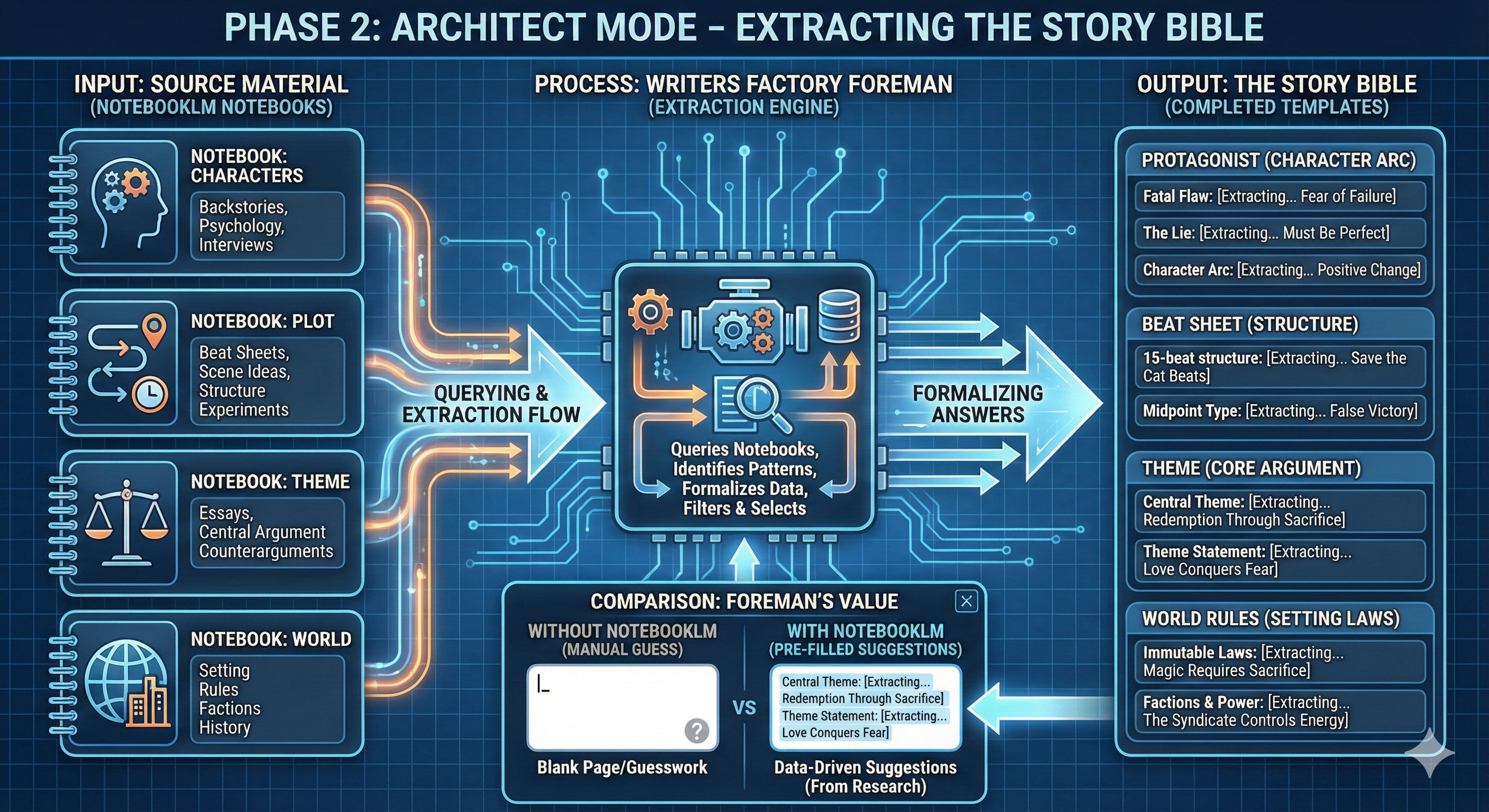
Phase 2: ARCHITECT Mode
Goal: Build your Story Bible through calibration, concept generation, and refinement.
Architect Mode has three sub-phases:
2a. Genre Calibration
A 5-minute wizard that captures your genre preferences:
- Primary genre (Fantasy, YA, Thriller, etc.)
- Secondary genre for blends (Romantasy = Fantasy + Romance)
- Pacing preferences (affects where beats fall)
2b. Concept Generation
The system cross-pollinates your ingredients to generate 5 complete novel concepts:
- Each concept combines character + world + theme + plot from different sources
- AI explains why each combination works together
- You select one, hybridize elements, or regenerate
Alternative: Use Concept Lab to manually select which ingredients to combine.
2c. Story Bible Seeding
Your selected concept becomes the canonical Story Bible:
Protagonist.md— Character psychology and arcBeat_Sheet.md— Structural turning pointsTheme.md— Central question and symbolsRules.md— World constraints
The Gate: You cannot advance to Voice Calibration until the Story Bible is complete.
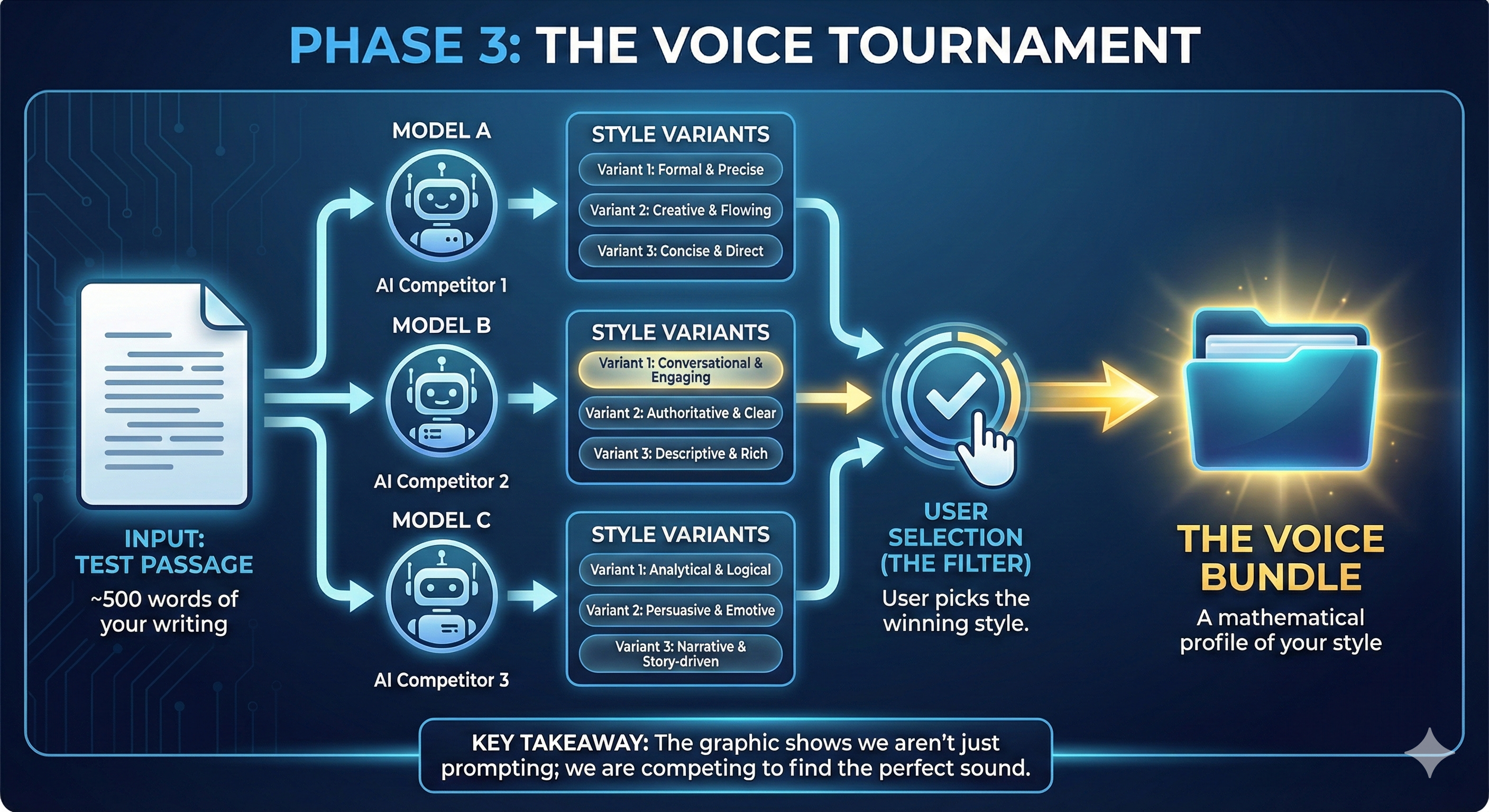
Phase 3: VOICE Mode
Goal: Find YOUR narrative voice through a tournament.
The #1 problem with AI is that it sounds generic. We solve this with Darwinian selection:
- The Input: You write a ~500-word test passage.
- The Tournament: 3+ AI models compete to rewrite it, each using 5 different strategies (Action, Character, Dialogue, Brainstorming, Balanced).
- The Selection: You review 15-25 variants and pick the winner.
- The Output: A Voice Bundle—reference files that govern all future generation.
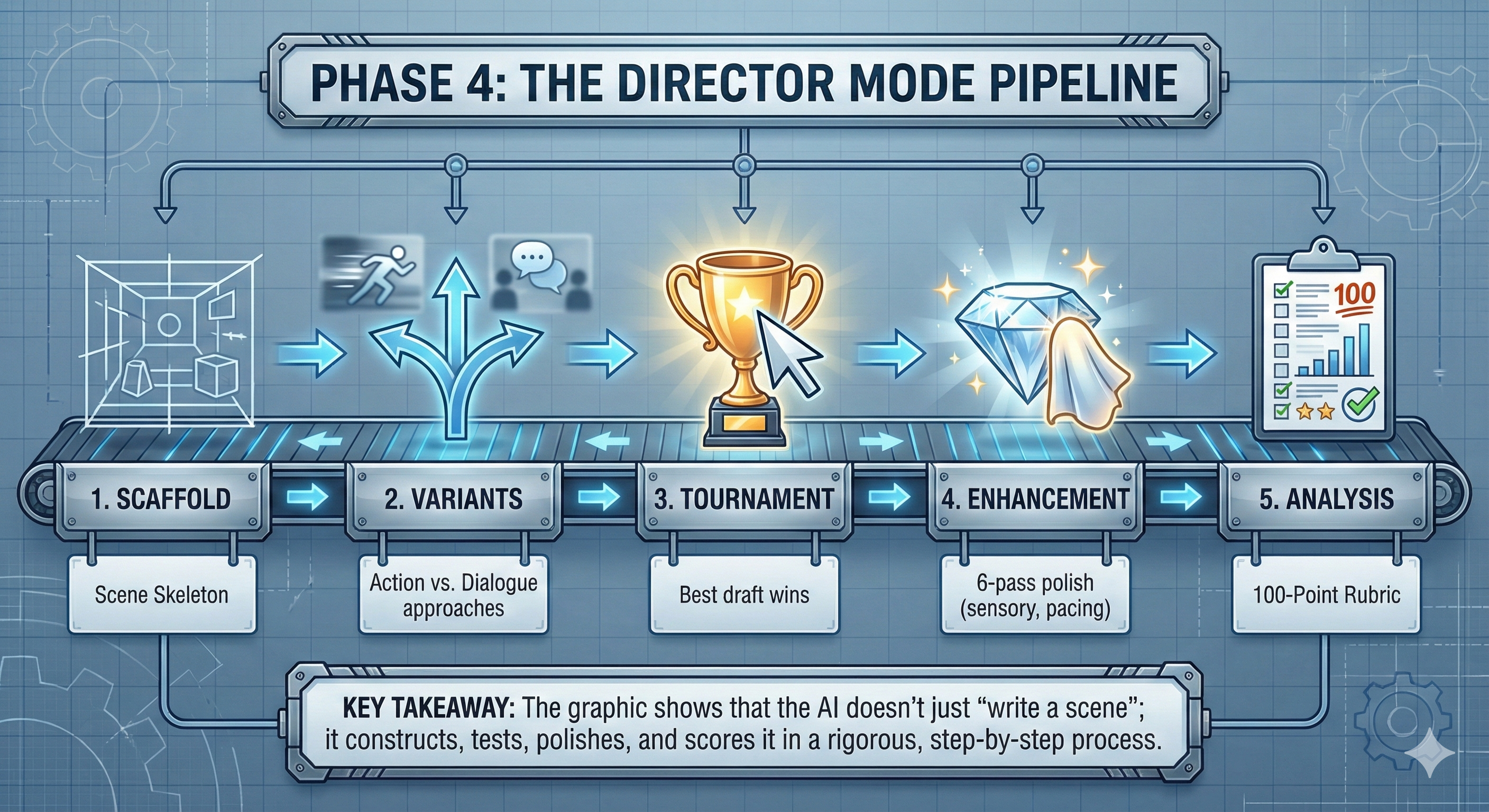
Phase 4: DIRECTOR Mode
Goal: High-speed drafting with rigorous quality control.
We treat scene creation like a manufacturing pipeline:
- Scaffold: AI generates a scene skeleton based on your beat sheet.
- Variants: Multiple approaches (Action-heavy vs. Dialogue-heavy).
- Tournament: Models compete to draft the scene.
- Analysis: Every scene is scored on a 100-Point Rubric (Voice Authenticity, Character Consistency, Metaphor Discipline).
- Verification: GraphRAG checks for contradictions, ensures callbacks to earlier setups, and updates the knowledge graph.
Phase 5: EDITOR Mode
Goal: Polish prose and ensure consistency.
After drafting, Editor Mode provides refinement tools:
- Voice Consistency Check: Verifies scenes match your calibrated voice
- Continuity Verification: GraphRAG flags contradictions with earlier scenes
- Pacing Analysis: Identifies slow spots and rushed sections
- Character Audit: Ensures dialogue matches established psychology
The Foreman switches to editorial mode, offering targeted suggestions rather than generating new content.
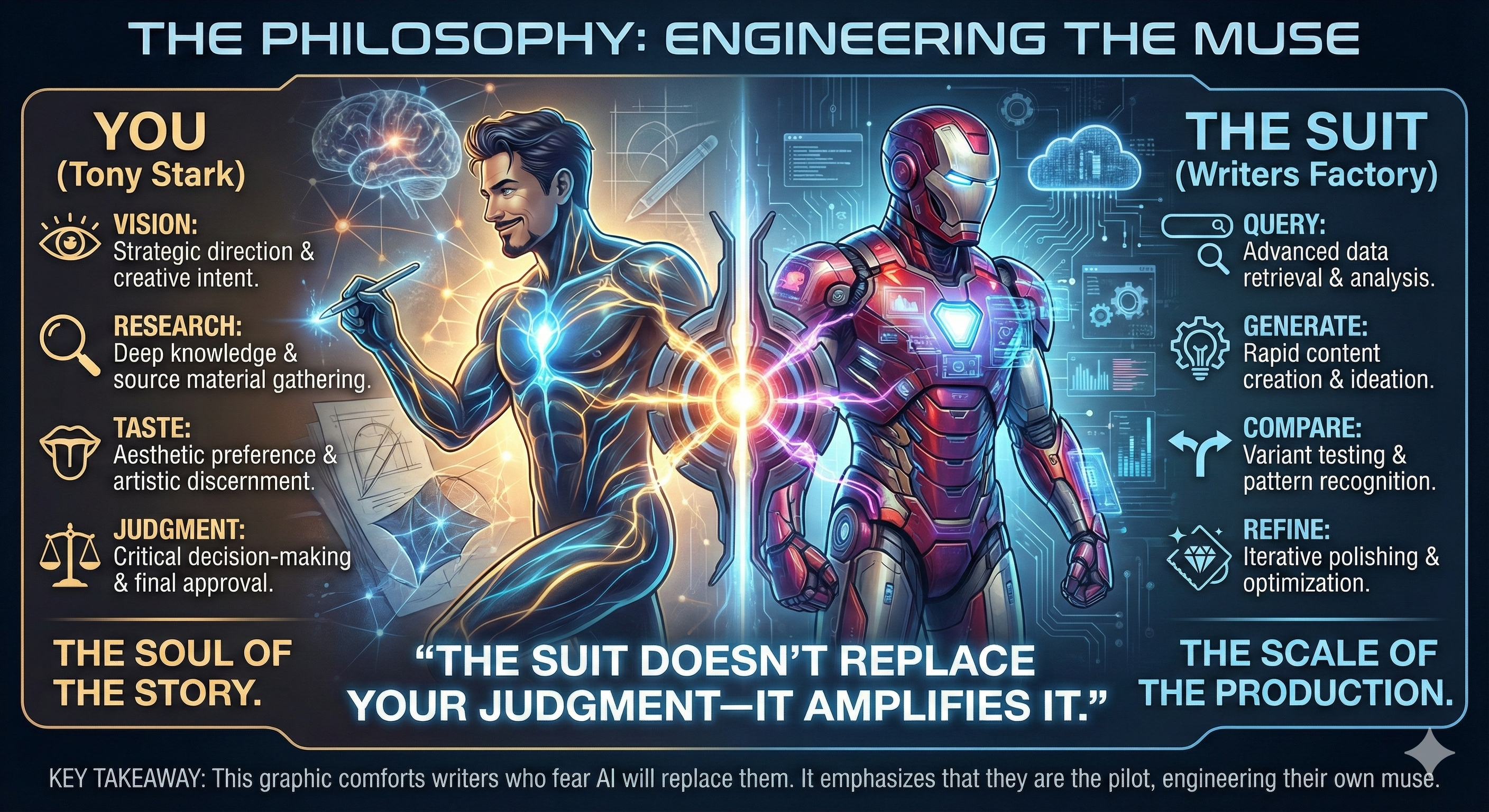
The Philosophy: Engineering the Muse
You are Tony Stark. Writers Factory is the suit.
The suit doesn’t replace your judgment—it amplifies it. It doesn’t write your novel—it extracts it from your research at superhuman speed.
- Your job: Provide the Vision, the Research, the Taste.
- The Suit’s job: Query, Generate, Compare, Refine.
Deep Dives
Ready to go deeper? Explore the technical documentation:
| Topic | Document |
|---|---|
| Getting Started | Choose Your Path |
| Genre Calibration | Teaching the System Your Genre |
| Concept Generation | From Ingredients to Novel Concepts |
| Voice Calibration | Voice Calibration System |
| Director Mode | Director Mode Pipeline |
| Editor Mode | Polish and Consistency |
| GraphRAG System | GraphRAG: The Living Brain |
| How Systems Integrate | Systems Integration |